Iraqi Brand Beef and Lamb Kebab

Masghouf fish, one of Iraq'southward national dishes, a Mesopotamian cuisine dating back to ancient times, typically fish caught from the rivers of Euphrates and Tigris, and grilled near the river bed.
Iraqi cuisine (Arabic: المطبخ العراقي) or Mesopotamian Cuisine [i] [2] is a Centre Eastern cuisine that has its origins from Sumerians, Akkadians, Babylonians, Assyrians and the other groups of the region.[3]
Tablets found in aboriginal ruins in Republic of iraq bear witness recipes prepared in the temples during religious festivals—the first cookbooks in the globe.[3] [4] Ancient Mesopotamia, was home to a sophisticated and highly advanced civilization, in all fields of knowledge, including the culinary arts.[3]
However, it was in the Islamic Gold Age when Baghdad was the upper-case letter of the Abbasid Caliphate (750–1258 AD) that the Iraqi kitchen reached its zenith.[3] Throughout history, the cuisine of Iraq has made extensive contact with the cuisines of its neighbouring regions including Caucasian cuisine, Greek Cuisine, Central Asian cuisine, Persian cuisine, and Turkish cuisine, amidst others. Today, the cuisine of Iraq reflects this rich inheritance as well as strong influences from the culinary traditions of neighbouring Iran, Turkey, and the Caucasus region.[three]
Mesopotamian cuisine varies across the land. The cooking of Northern Iraq is known for adding pomegranate to the dolma juice prominently to give it a unique gustatory modality. In Southern Republic of iraq, fish is used extensively. While in the middle region, in Baghdad and the surrounding cities is known for its variety of rice dishes and sweets.
Contemporary Republic of iraq reflects the same natural division as aboriginal Mesopotamia,[five] [six] [7] [8] which consisted of Assyria in the arid northern uplands and Babylonia in the alluvial evidently.[8] Upper Mesopotamia grows wheat and crops requiring winter chill such as apples and stone fruits.[viii] Lower Mesopotamia grows rice and barley, citrus fruits, and is responsible for Iraq's position every bit ane of the world'south largest producer of dates.

History [edit]
Archaeologists take found testify from excavations at Jarmo in northeastern Republic of iraq, that pistachio nuts were a common nutrient equally early equally 6750 BC.[9] Among the ancient texts discovered in Mesopotamia is a Sumerian-Akkadian bilingual dictionary,[ten] recorded in cuneiform script on 24 rock tablets nigh 1900 BC.[10] Information technology lists terms in the two aboriginal Iraqi languages for over 800 different items of food and drink.[ten] Included are xx unlike kinds of cheese, over 100 varieties of soup and 300 types of bread, each with unlike ingredients, filling, shape or size.[10]
The world's oldest recipes are found in Mesopotamia of mod-mean solar day ancient Republic of iraq, written in cuneiform tablets.[11] [four] One of iii excavated cuneiform clay tablets written in 1700 BC in Babylon,[12] [11] l miles south of nowadays-day Baghdad, contains 24 recipes for stew cooked with meat and vegetables,[12] enhanced and seasoned with leeks, onion, garlic, and spices and herbs like cassia, cumin, coriander, mint, and dill.[12] Stew has remained a mainstay in the cuisine.[12] Extant medieval Iraqi recipes and modernistic Iraqi cuisine attest to this.[12]
Iraqi cuisine/Mesopotamian cuisine [edit]
Ingredients [edit]

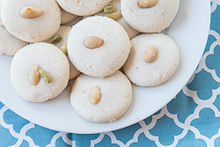
Kleicha is sometimes considered the national cookie of Iraq and is served during religious holidays.
Some characteristic ingredients of Iraqi cuisine include:
- Vegetables such as eggplant, tomato, turnips, beans, shallots, okra, onion, lentils, cress, spud, cabbage, courgette (zucchini), spinach, lettuce, leeks, artichokes, garlic, peppers and chilli peppers.
- Cereals including rice, bulghur wheat and barley.
- Pulses and legumes such as lentils, chickpeas, green beans, green grams, and cannellini beans.
- Fruits including olives, dates, raisins, apricots, plums, figs, grapes, melons, pomegranates, apples, cherries, quinces, and citrus fruits—oranges, lemons and limes.
- Cheeses such every bit baladi, feta and halloumi.
- Herbs and spices including cinnamon, cardamom, coriander, fenugreek, cumin, oregano, mint, tarragon, thyme, saffron, dried lime, cassia, dill, turmeric, baharat, advieh, sumac and za'atar.
- Nuts and seeds such as sesame, pistachios, almonds, walnuts, hazelnuts and pine nuts.
Other Iraqi culinary essentials include olive oil, sesame oil, tamarind, vermicelli, tahini, honey, appointment syrup, yogurt and rose water.
Lamb is the favorite meat, but craven, beef, caprine animal and fish are as well eaten. Virtually dishes are served with rice—normally timman anbar, a yellowish, very aromatic, long-grain rice grown in the Middle Euphrates region.[13]
Bulghur wheat is used in many dishes, having been a staple in the country since the days of the ancient Assyrians.[3] Flatbread is a staple that is served with a diverseness of dips, cheeses, olives, and jams, at every repast.
Mêzzä [edit]
Meals begin with appetizers and salads, known as mezza. Mezza is a option of appetizers or small dishes often served with a potable, like anise-flavored liqueurs such equally arak, ouzo, rakı, sambuca, pastis, or various wines, like to the tapas of Kingdom of spain, or finger nutrient.
Mezza may include:

- Iraqi sumac salad, is a typical raqi salad with the addition of sumac berries.[14]
- Baytinijan maqli, a dish ofttimes served cold, consisting of fried aubergine (eggplant) with tahini, lettuce, parsley and tomatoes, garnished with sumac and served on pita bread or sliced bread, oftentimes grilled or toasted. Variations include bell peppers, or a garlic-lemon vinaigrette.
- Fattoush, a salad made from several garden vegetables and toasted or fried pieces of pita staff of life.
- Tabbouleh, a salad dish, oft used every bit part of a mezze. Its main ingredients are finely chopped parsley, bulgur, mint, tomato, scallion, and other herbs with lemon juice, olive oil and various seasonings, by and large including black pepper and sometimes cinnamon and allspice.
- Turshi, pickled vegetables in the cuisine of many Balkan and Middle East countries. It is a traditional appetizer, mezze for rakı, ouzo, tsipouro and rakia.
Dips [edit]
- Baba ghanoush, a dish of baked aubergine (eggplant) mashed and mixed with various seasonings.
- Hummus, a dip or spread made from cooked, mashed chickpeas, blended with tahini, olive oil, lemon juice, salt and garlic.
- Tzatziki, an appetizer, besides used as a sauce for souvlaki and gyros.
- Tzatziki is fabricated of strained yogurt (normally sheep'south milk or caprine animal'southward milk in Greece and Turkey) with cucumbers, garlic, salt, usually olive oil, pepper, dill, sometimes lemon juice and parsley, or mint added. The cucumbers are either puréed and strained, or seeded and finely diced. Olive oil, olives, and herbs are often used equally garnishes.
Soups and stews [edit]
Diverse stews served over rice form a major function of Iraqi cuisine.
- Fasolia yabsa (Iraqi white bean stew), fabricated up of tender lamb or veal, white kidney beans (also chosen cannellini beans), tomato sauce and served over rice.[15]
- Fasoulia, a soup of dry out white beans, olive oil, and vegetables.
- Fesenjān, a thick, tart stew made from pomegranate syrup and ground walnuts (encounter bazha [xvi]), traditionally fabricated with poultry (duck or craven).
- Harissa, similar to keşkek, a porridge made of stewed and boned chicken and coarsely footing soaked wheat.
- Kebabs, a dish consisting of grilled or baked meats on a skewer or stick.[17] The most mutual kebabs include lamb and beef, although others utilise chicken or fish.
- Lentil soup, may exist vegetarian or include meat, and may utilise brown, crimson, yellowish or black lentils, with or without the husk.
- Maqluba, an upside-downward rice and aubergine (eggplant) casserole, hence the name which means "upside-down". Information technology is sometimes fabricated with fried cauliflower instead of aubergine and usually includes meat—oftentimes braised lamb.[18]
- Margat bamia or just bamia, a stew made with okra and lamb or beefiness cubes in a tomato sauce.[19]
- Margat baytinijan, an aubergine-based dish of the Balkans and the Middle East. All versions are based primarily on sautéed aubergine (eggplant) and tomato, normally with minced meat.


- Masgouf, a traditional Mesopotamian dish made with fish from the Tigris.[17] [20] It is an open up-cutting freshwater fish roasted for hours later being marinated with olive oil, table salt, curcuma and tamarind while keeping the peel on. Traditional garnishes for the masgouf include lemon, chopped onions and tomatoes, as well as the dirt-oven flatbreads common to Iraq and much of the Center East.
- Pomegranate soup, called shorbat rumman in Iraq. It is made from pomegranate juice and seeds, yellow dissever peas, footing beefiness, mint leaves, spices, and other ingredients.[21]
- Qeema, a minced meat, lycopersicon esculentum and chickpea stew, served with rice. Traditionally prepared at the annual Ashura commemorations in southern Iraq. The name qeema is an ancient Akkadian word meaning "finely chopped".[22]

- Quzi, blimp roasted lamb.[17] [20]
- hikakeh is a thin crust of slightly browned rice at the bottom of the cooking pot.

- Tashrib, a soup made with either lamb or chicken with or without tomatoes eaten with Iraqi nan; the bread is broken into pieces and the soup is poured over in a large bowl.
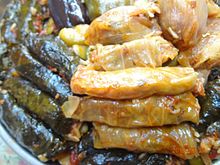

- Tepsi baytinijan, an Iraqi goulash. The main ingredient of the dish is aubergine (eggplant), which is sliced and fried before placing in a baking dish, accompanied with chunks of lamb/beefiness/veal and/or meatballs, plus tomatoes, onions and garlic.
- Tater slices are placed on meridian of the mixture, and the dish is baked. Like many other Iraqi dishes it is unremarkably served with rice, along with salad and pickles.
Dumplings and meatballs [edit]
- Dolma (sarma), a family of stuffed vegetable dishes. The grape-foliage dolma is common. Courgette (zucchini), aubergine (eggplant), tomato and pepper are commonly used as fillings. The stuffing may or may not include meat.[23]
- Falafel, a fried ball or patty made from spiced chickpeas or fava beans. Originally from Egypt, falafel is a form of fast nutrient in the Middle Due east, where information technology is as well served every bit a mezze.
- Kofta, a family of meatball or meatloaf dishes in Middle Eastern, Indian, and Balkan cuisines. In the simplest form, koftas consist of balls of minced or basis meat—commonly beef or lamb—mixed with spices or onions.
- Vegetarian varieties include lauki kofta,[24] shahi aloo kofta,[25] and malai kofta.[26]
- Kubba, a dish made of burghul, chopped meat, and spices. There are many varierities. The best-known diverseness is a torpedo-shaped burghul shell blimp with chopped meat and fried. Other varieties are baked, poached, or fifty-fifty served raw. They may be shaped into assurance, patties, or flat.[21]


- Samosa, a small fried or baked viscid, which may be either half-moon shaped or triangular.
Processed meat [edit]
- Pastırma, a highly seasoned, air-stale cured beef in the cuisines of the quondam Ottoman countries.
- Sujuk, a dry, spicy sausage eaten from the Balkans to the Middle East and Central Asia.
Rice dishes [edit]
Long-grain rice is a staple in Iraqi cuisine.[17] [20]
Iraqi rice cooking is similar to the method used for Iranian chelow,[13] a multistep process intended to produce just-tender, fluffy grains.[13] A prominent aspect of Iraqi rice cooking is the hikakeh, a crisp bottom crust.[thirteen] Information technology differs slightly from the Iranian tahdig, which is a single thick piece; the hikakeh contains some loose rice besides.[13] Before serving, the hikakeh is broken into pieces so that everyone is provided with some along with the fluffy rice.[13]
- Dolma (sarma), vine leaves stuffed with a mixture of ground lamb or beef with rice cooked with many fillings in the aforementioned pot, with pomegranate juice prominently added by Due north Iraqis to give information technology a unique taste.
- The Assyrians of Republic of iraq may either call it dolma or yaprekh which is the Syriac term for stuffed grape leaves.
- Iraqis usually serve dolma without yoghurt. Often chicken or beef ribs are added to the cooking pot, and sometimes served with the dolma instead of masta or khalwah. Iraqi dolma is usually cooked and served in a love apple-based sauce.
- Dolma is very pop in Iraq. In Mosul they include courgettes (zucchini), tomatoes, onions, peppers and grape leaves. They are occasionally smoked.
- Biryani, several rice-based foods made with spices, rice (unremarkably basmati), and meat/vegetable, collectively pop in Iraq, Iran, Afghanistan, Pakistan, Bangladesh, India and among Muslims in Sri Lanka.
- Mutabbaq samak (Arabic: مطبق سمك), fried fish served over stocked rice.[27] [28]
- Pilaf, like to that of Iran.
- Quzi, a rice-based dish served with very slow-cooked lamb and roasted nuts and raisins.
- Tibeat, a Jewish-Iraqi dish made for Shabbat, slow-cooked craven stuffed with rice, tomatoes, dried apricots and raisins, with a stiff cardamom flavour.[29]
Sandwiches and wraps [edit]
- Shawarma, a Middle-Eastern Arabic-manner sandwich-similar wrap[17] usually composed of shaved lamb, goat, chicken, turkey, beefiness, or a mixture of meats. Shawarma is a popular dish and fast-food staple beyond the Centre Due east and North Africa.
Dairy [edit]
- Baladi cheese, a soft, white cheese originating from the Centre East, with a mild notwithstanding rich flavor.
- Geimar, a creamy dairy product, similar to clotted cream, made in the Balkans, Turkey, Iran and Central Asia. It is made from water buffalo's milk in the East, or cow'southward milk in the Westward.
- Jameed, difficult dry labneh (strained yogurt) made from sheep's milk.
- Jibneh Arabieh, a elementary cheese found all over the Middle East, specially popular in the Farsi Gulf area, with an open texture and a mild gustation similar to feta, simply less salty.
- Labneh, yogurt which has been strained in a cloth or paper bag or filter, traditionally made of muslin, to remove the whey, giving a consistency between that of yogurt and cheese, while preserving yogurt's distinctive sour sense of taste.[21]
Breads and pastries [edit]
- Burek, a type of baked or fried filled pastry. It is made of a sparse flaky dough known equally phyllo dough (or yufka dough), and are filled with salty cheese (oftentimes feta), minced meat, potatoes or other vegetables.
- Ka'ak, refer to several different types of baked goods produced throughout the Arab globe and the About East.
- Kadaif, a very fine vermicelli-like pastry used to make sugariness pastries and desserts.
- Kahy, layers of thin dough phyllo usually consumed warm for breakfast by calculation flossy kaymak and light sugar syrup.
- Khubz Iraqi, an Arabic flatbread that is role of the local diet in many countries of Western Asia.
- Laffa (an Iraqi pita or naan bread).
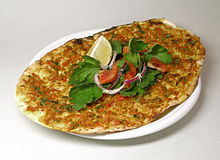
- Lahmacun, a thin pizza topped with minced meat and herbs.
- Lavash, a soft, thin flatbread.
- Manakish, a pizza consisting of dough topped with thyme, cheese, or basis meat.
- Markook, a blazon of flatbread common in the countries of the Levant. Information technology is baked on a domed or convex metal griddle, known as saj. Information technology is usually sizable, about two feet, thin, about transparent.
- Pita, a family of yeast-leavened round flatbreads baked from wheat flour.
- Samoon, a flat and round bread.[20]
- Sfiha, a pizza-like dish traditionally fabricated with basis mutton rather than the more modern addition of lamb or beef in Brazil. They are open-faced meat pies with no top dough.
- Sfiha are much similar dolma, ground lamb, lightly spiced, wrapped in brined grape leaves.
Condiments, sauces and spices [edit]
- Amba, a tangy mango pickle condiment from Pakistan and Bharat. Commonly eaten as a side dish and sometimes every bit a sandwich topping.
- Baharat, a spice mixture. Typical ingredients include allspice, blackness pepper corns, cardamom seeds, cassia bark, cloves, coriander seeds, cumin seeds, nutmeg, dried crimson chili peppers or paprika.
- Dibis, a thick, very sweet appointment syrup. Often mixed with tahini to create a dip.
- Jallab, a type of syrup popular in the Middle East made from dates, grape molasses and rose water.
- Mahleb, an aromatic spice made from the seeds of the St Lucie Carmine (Prunus mahaleb).
- Rose water (Mayy wared), used in various Middle-Eastern dishes, especially in sweets.
- Tahini (t'heena), a paste of footing sesame seeds used in cooking. Middle-Eastern tahini is made of hulled, lightly roasted seeds.
- Za'atar, a mixture of herbs and spices used every bit a additive.
Sweets [edit]
The earliest known recipe for cake comes from ancient Mesopotamia. Believed to be primarily for consumption at the palace or temple, the block was made from fat, white cheese, dates and raisins. Another recipe dating to the reign of Hammurabi (1792 BCE–1750 BCE) includes similar basic ingredients with the improver of grape syrup, figs and apples.[30]
The traditional Iraqi kleicha cookies are believed to take their roots in Mesopotamian qullupu—date filled pastries broiled in a wood-fired oven called tannour. In modern times, other types of cookies (biskit) and cakes (ka'ak) are fabricated at dwelling house, unremarkably flavored with cardamom or rose h2o. Some variations include the disc-shaped khfefiyyat, one-half-moon shaped kleichat joz fabricated with basics, and engagement-filled kleichat tamur.[30]

"White baklava", osh el bulbul (bird'southward nests) and other traditional sweets in Republic of iraq
Cookbooks dating to the Abbasid Caliphate between the 10th and 13th centuries include recipes for hundreds of desserts. The tradition continues into the modern twenty-four hours, only the rich, syrupy desserts like baklava are usually prepared for special occasions or religious celebrations, as most daily meals are normally followed by a simple grade of seasonal fruit, especially dates, figs, cantaloupes, nectarines, apricots, pomegranates, peaches, mulberries, grapes or watermelons.[xxx]

Though non as recognizable every bit baklava, the fried pastry called lauzeenaj, flavored with mastic and rose h2o, was a specialty in purple Baghdad.
Rosette-shaped fritters called zalabia are a local specialty, believed to take their proper name from Ziryab, a well-known Kurdish-Iraqi musician in the Caliphate of Cordoba.
Baklava and zalabia are typical offerings during the Eid al-Fitr celebrations that follow Ramadan. Halqoum (commonly known equally Turkish delight) are traditionally given every bit gifts during the vacation.[thirty]
Others include:
- Halva, popular in the Balkans, Poland, Middle East, and other areas surrounding the Mediterranean Bounding main. The primary ingredients in this confection are sesame butter or paste (tahini), and saccharide, glucose or honey.
- Kanafeh, a pastry made with layers of semolina, white cheese and a sugary syrup sprinkled with rose h2o.
- Luzina, a candy like to Turkish lukum, fabricated from ground fruits.
- Isle of man al-sama, an Iranian nougat that originated in Isfahan.
- Qatayef, an Arab dessert reserved for the Muslim holiday of Ramadan, a sort of sweet crêpe filled with cheese or nuts. It was traditionally prepared by street vendors likewise equally households in the Levant and more recently has spread to Egypt.
Beverages [edit]
Alcoholic beverages [edit]
Alcoholic beverages in Iraq are widely available everywhere with sure exceptions in Karbala and Najaf for religious reasons.[ citation needed ] Iraqis are great consumers of all kinds of alcohol except for those who follow the religious code.[ citation needed ]

Alulu beer receipt – This records a purchase of "best" beer from a brewer, c. 2050 BC from the Sumerian city of Umma in ancient Iraq.[31]
- Arak, a articulate, colourless, unsweetened anise-flavoured distilled alcoholic drinkable. Arak is usually not consumed straight, but is mixed in approximately ⅓︎ arak to ⅔︎ water, and ice is so added.[32] [33]
- Beer, a drinkable that originated in ancient Assyria and Babylon over 6,000 years agone.
- Cusa Masqool, an alcoholic potable which is made from fermented goats milk. It's mostly simply found in the Kurdistan region and dates back to artifact.,
Non-alcoholic beverages [edit]
- Coffee, a potable that has a strong and bitter taste, a pop beverage in Iraq.
- Sharbat, a chilled, sweet drink prepared from fruit juice or flower petals.
- Shinēna, a cold drink of yogurt mixed with cold water, sometimes with a pinch of table salt or dried mint added.
- Tea, also known as chai, is widely consumed throughout the twenty-four hour period, specially in the mornings, after meals, and during social settings. It is prepared in a special mode involving boiling tea in hot water, then placing information technology over a second tea pot with boiling h2o to let the tea infuse.

Iraqi tea is renowned for existence considerably stronger, richer and sweeter than those institute in neighbouring countries, and is usually brewed with heil (cardamom)
[edit]
- Armenian cuisine
- Assyrian cuisine
- Azerbaijani cluster cuisine
- Caucasian cuisine
- Cardinal Asian cuisine
- Iranian cuisine
- Levantine cuisine
- Mediterranean cuisine
- Middle Eastern cuisine
- Turkish cuisine
See also [edit]
- Culture of Iraq
- Mesopotamia
- Masgouf
- Chelfray
- Kleicha
- Lokma
- Samoon
- Quzi
- Kaymak
- Tandoor bread
- Amba
- Ibn Sayyar al-Warraq
References [edit]
- ^ "Tasty Ancient Recipes from Mesopotamia – History et cetera". Retrieved 2021-12-27 .
- ^ "Iraqi Cuisine". worldfood.guide . Retrieved 2021-12-27 .
- ^ a b c d e f http://world wide web.thingsasian.com/stories-photos/3592 Foods of Republic of iraq: Enshrined With A Long History. Habeeb Salloum.
- ^ a b "Inspired by the oldest clay tablet 'cookbook' in the earth (1700 BC) | Foodpairing / blog". Foodpairing. 2015-09-xv. Retrieved 2020-05-29 .
- ^ "Tasty Ancient Recipes from Mesopotamia – History et cetera".
- ^ "The Ancient Mesopotamian Tablet equally Cookbook | Roundtable". Lapham's Quarterly.
- ^ "Iraqi Cuisine". worldfood.guide.
- ^ a b c Davidson, Alan; Jaine, Tom (2006). The Oxford Companion to Food. Oxford University Press. p. 405. ISBN978-0-19-280681-9.
- ^ "History and Agriculture of the Pistachio Nut". IRECO. Archived from the original on 13 July 2006. Retrieved 27 Feb 2012.
- ^ a b c d Lawton, John. "Mesopotamian Menus". Saudi Aramco Globe, March/April 1988. Saudi Aramco. Retrieved 30 March 2012.
- ^ a b Winchester, Ashley. "The world'south oldest-known recipes decoded". www.bbc.com . Retrieved 2020-05-29 .
- ^ a b c d eastward Albala, Ken (2011). Food Cultures of the World Encyclopedia. ABC-CLIO. pp. 251–252. ISBN978-0-313-37627-6.
- ^ a b c d eastward f Marks, Gil (2010). Encyclopedia of Jewish Food. John Wiley & Sons. p. 585. ISBN978-0-470-39130-3.
- ^ "Iraqi Sumac Salad (Summaq salad)". 14 January 2016.
- ^ "Fasolia Yabsa (Iraqi White Edible bean Stew)". 22 September 2020.
- ^ Wikipedia https://www.kosher.com/recipe/bazha-georgian-walnut-sauce-2695
- ^ a b c d east ʻAlī Akbar Mahdī, (2003) p.xl -41
- ^ Jacob (2007) p.4
- ^ Off-white, (2008) p.72
- ^ a b c d Taus-Bolstad, Stacy (2003) Iraq in Pictures, Twenty-Kickoff Century Books, p.55, ISBN 0-8225-0934-2
- ^ a b c Jacob (2007) p.2
- ^ Nasrallah, Nawal (2003). Delights from the Garden of Eden: A Cookbook and a History of the Iraqi Cuisine. 1stBooks. p. 221. ISBN978-i-4033-4793-0.
- ^ Fair, (2008), p.71
- ^ "Lauki Kofta Curry Recipe / Dudhi Kofta Curry / Bottle Gourd Kofta". 27 February 2019.
- ^ "Shahi Aloo kofta curry Recipe". 6 March 2020.
- ^ "Malai kofta recipe | How to make malai kofta back-scratch | Paneer kofta". 27 August 2017.
- ^ Albala, Ken (2011-05-25). Food Cultures of the World Encyclopedia [4 volumes]: [Four Volumes]. ABC-CLIO. ISBN978-0-313-37627-half dozen.
- ^ Nasrallah, Nawal (2013). Delights from the Garden of Eden: A Cookbook and History of the Iraqi Cuisine. Equinox Pub. ISBN978-1-84553-457-8.
- ^ "Chicken and rice (Tibeat)". 15 November 2011.
- ^ a b c d Roufs, Timothy G.; Roufs, Kathleen Smyth. Sweet Treats Effectually the Earth. pp. 179–183.
- ^ "Looking for oldest pump". Globe Pumps. 2010 (11): 11. November 2010. doi:ten.1016/s0262-1762(ten)70355-2. ISSN 0262-1762.
- ^ "Iraq: Happy hour". Jan xxx, 2008.
- ^ Zeed, Adnan Abu (October 12, 2018). "Arak distillery promotes ambitious new brand in defiance of alcohol ban". Al-Monitor.
Bibliography [edit]
- ʻAlī Akbar Mahdī, (2003) Teen life in the Middle Eastward, Greenwood Publishing Group, p. 40 -41 ISBN 0-313-31893-Ten
- Jacob, Jeanne; Ashkenazi, Michael. (2007) The Globe Cookbook for Students, Greenwood Publishing Group p. i - 5 ISBN 0-313-33455-2
- Nasrallah, Nawal (2003) Delights from the Garden of Eden: A Cookbook and a History of the Iraqi Cuisine, 1stBooks, ISBN ane-4033-4793-X
External links [edit]
- Iraqi Nutrient and Cuisine
- Delights from the Garden of Eden - A Cookbook and History of Iraqi Cuisine
- Aboriginal Mesopotamian cuisine
williamsounts1973.blogspot.com
Source: https://en.wikipedia.org/wiki/Iraqi_cuisine
0 Response to "Iraqi Brand Beef and Lamb Kebab"
Post a Comment